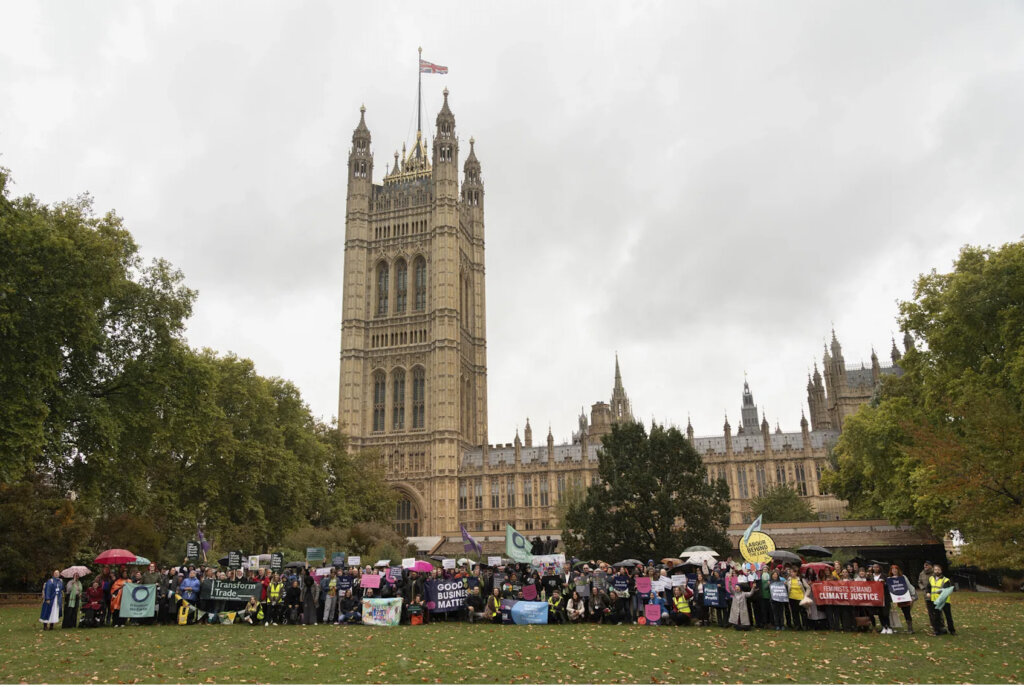
A lobby of the UK Parliament on 21 October calling for a new law to hold UK companies to account for human rights abuses and environmental destruction in their supply chains marked just the latest in a growing campaign coordinated by the Corporate Justice Coalition (CJC), of which Banana Link is a member.
The lobby saw activists and campaigners invite politicians to sign the Good Business Matters pledge, calling for a new mandatory law on business, human rights, and the environment, and which is already backed by more than 80 parliamentarians.
The CJC is the UK’s leading corporate accountability network, and brings together organisations including the TUC, Amnesty International, UNICEF, the Fairtrade Foundation, Global Justice Now, War on Want, the World Wildlife Fund and Focus on Global Exploitation, in its campaign for a new law.
A Business, Human Rights and Environment Act would bring UK legislation in line with international human rights standards and with mandatory human rights and environmental due diligence legislation in the European Union. It would go further than EU. Legislation in that not only would it require UK companies to identify and prevent human rights and environmental harms across their domestic operations and their global value chains but would also apply to public institutions. It would ensure real consequences for companies that are exploiting people and destroying the planet and would enable victims to access justice and demand compensation.
Under similar legislation in Germany, for example, banana workers in Costa Rica have received compensation payments following a complaint by Oxfam Germany and the Costa Rican trade union SITRAP regarding labour rights violations at an Aldi banana supplier in the country.
In partnership with Ekō, Anti-Slavery International, Freedom United, Transform Trade and Friends of the Earth, the CJC has already gathered 145,000 signatures demonstrating vast public support for a new UK law and delivered this message directly to the Prime Minister.
Report reveals human rights violations and environmental damage in public procurement supply chains, including bananas
The lobby of Parliament also coincided with the publication of a report by the Fabian Society – Just Values: promoting human rights through Britain’s value chains at home and abroad – which revealed the extent to which Britain’s commercial activity is contributing to human rights violations and environmental damage around the world. According to the report UK public sector spends around £2.4bn a year on food, and buys millions of bananas for schools, hospitals, care homes, the military and prisons. In 2023, the UK’s largest public framework for banana supply, valued at £32.9m, was shared between just seven fruit companies, including Del Monte and Dole, and only one winner was an SME. The single largest banana contract, which supplies the School Fruit and Vegetable Scheme with 83m bananas a year, is worth almost £7m.
Forthcoming research by Banana Link has found that public sector supply chains lack transparency and often the countries supplying bananas have some of the worst conditions in the world for workers:
- Costa Rica, the origin most cited by public buyers, is rated by the International Trade Union Confederation as a country of systematic rights violations.
- Ecuador, the leading exporter globally, ranks in the 10 worst countries for workers, with documented state surveillance, detention, union interference, and state violence during strikes.
- Guatemala hosts Chiquita-owned plantations where an investigation by Public Eye found workers on 12-hour shifts in extreme heat, facing demanding targets, and inadequately protected from hazardous pesticides banned in Europe – like Mancozeb, a fungicide which is known to be toxic to reproductive and hormonal systems. They were found working on precarious contracts and risked dismissal or blacklisting should they join a union to improve their conditions.
Environmental harms and labour harms exist in tandem, often in the same places. The intensive model that suppresses wages and unions relies on heavy pesticide and fungicide use, including aerial spraying that harms workers and the surrounding communities, water, and soils.
The Fabian Society calls on the UK Government to bring forward legislation for a duty on business and public bodies to prevent human rights and environmental harm in their value chains, which should aim to:
- Require regular due diligence and demand reasonable preventative action where risks or potential harms are identified.
- Cover whole value chains with expectations proportionate to a company’s size and risk.
- Strengthen transparency in where goods come from and in findings of harm, providing workers, businesses, public actors, and consumers with more knowledge to make informed choices and hold businesses to account.
- Enforce regulations through an independent, well-resourced regulator, with an effective remit to enforce the duty and prevent harms, and penalties strong enough to deter it rather than be priced in.
- Reverse the burden of proof so that its falls on businesses – who would need to show compliance and reasonable action to prevent harm – rather than on the victims of harms.
- Provide genuine access to remedy for those harmed.
- Use income from fines and penalties to fund investigation, remediation, and access to justice for victims.
- Require meaningful engagement with workers and their trade unions, and with women’s rights and other civil society organisations, in the design, monitoring, investigation, and remedy of due diligence.
- Provide clarity, so that it is easier for businesses to comply with responsible business duties than today’s complex frameworks.
- Create a level playing field so that responsible firms are not undercut by those operating to lower standards, and co-operate internationally, including with the EU, to improve standards globally.
Photo: UNISON