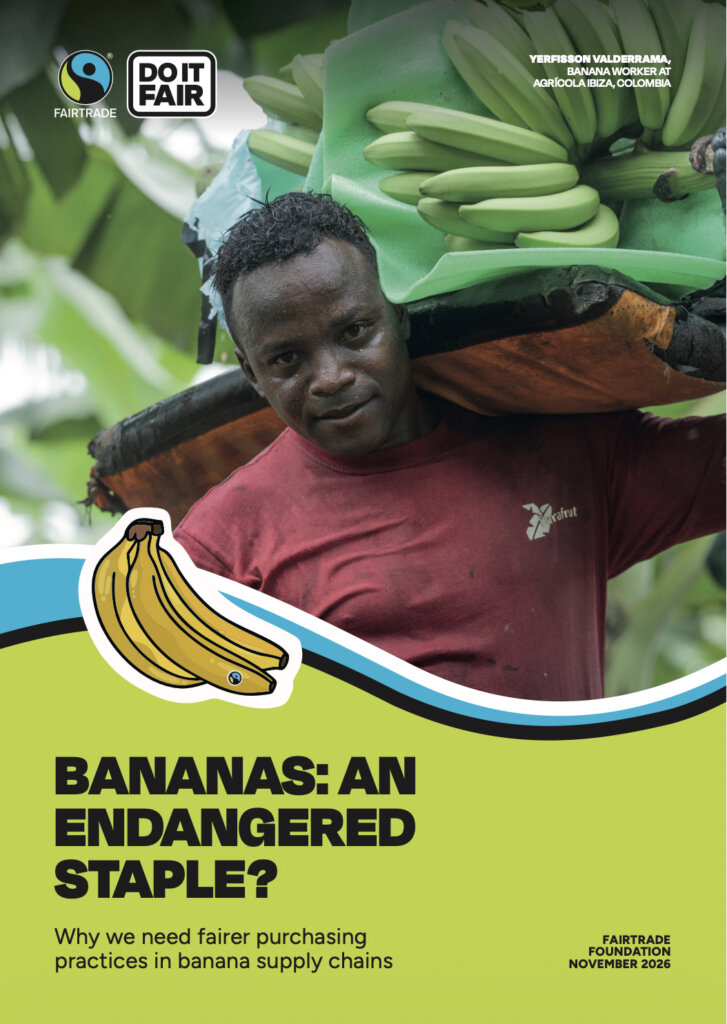
A new report – Bananas: An Endangered Staple – just published by the Fairtrade Foundation shows how persistent downward pressure on prices, late payments, last-minute cancellations and unfair penalties are pushing risk down the supply chain, leaving the people who grow our bananas to bear costs they cannot afford.
Whilst UK consumers enjoy cheap bananas which can cost as little as 15p each, many of the people who grow them are not receiving prices that cover the true cost of production, as climate and economic costs intensify.
Fairtrade is calling on the UK Government to tackle Unfair Trading Practices (UTPs) through a new Human Rights and Environmental Due Diligence (HREDD) law.
New Fairtrade analysis shows past El Niño events have reduced banana productivity in major exporting countries, raising concerns for livelihoods, working conditions and future supplies as we enter a Super El Niño event.
Despite continued cost of living pressures, there is public support for change: 67% of Britons say they would be willing to pay a little more for bananas if it helped farmers tackle climate change and disease.
Bananas are the world’s most popular fruit. In the UK, each of us eats about 12kg of bananas, or roughly 100 bananas, every year, while 10 – 12 million worldwide depend on bananas for their livelihoods. Yet a new report published by the Fairtrade Foundation, which includes analysis carried out by independent advisors 3Keel, shows that the people who grow them are being left to shoulder the combined pressures of unfair trading practices (UTPs) and a worsening climate crisis, putting their livelihoods and the future of bananas at risk.
Prices paid to the people growing our bananas may not cover production costs or provide a decent living, while unpredictable payments and orders make it harder to pay bills, feed families and avoid debt. Squeezed plantations may cut wages, jobs, safety equipment or rely more heavily on temporary contracts, while farmers have less money to invest in irrigation, disease prevention and other measures needed to withstand increasingly extreme and volatile conditions.
Yet while bananas are becoming harder and more expensive to produce, supermarket prices have remained unchanged for almost 40 years, despite rising costs for fertiliser, fuel and labour.
Farmers and workers have told Fairtrade that these pressures are causing a downward spiral, meaning they are less able to withstand climate shocks, while those shocks deepen their financial hardship.
The human stakes are substantial: between 10 and 12 million people worldwide rely on bananas for their livelihoods.
Ever Antonio Flores Muños, a banana worker at AGROSIETE in Colombia, said:
“Over the past 10 years, the climate has changed a lot. It’s been getting much hotter… it’s really intense. Some places have had losses due to the climate, flooding, strong winds. It’s going to affect all of us – our workers, colleagues – everything will be at great risk, and our wages will decrease.”
The Fairtrade Foundation is calling on the UK Government to tackle unfair trading practices through a new Human Rights and Environmental Due Diligence (HREDD) law. While some businesses have taken positive voluntary steps, Fairtrade argues that legislation is needed to ensure harmful purchasing practices are addressed across the sector.
The threat to future banana supplies is growing. Around 93% of bananas imported into the UK come from climate-vulnerable regions in Latin America and West Africa.[1]
New Fairtrade analysis found that during the 2023-24 El Niño, banana productivity fell by 22% in Ecuador, 13% in the Dominican Republic and 6% in Peru. Another anticipated Super El Niño could place further pressure on production and supplies.[2] Climate change is also increasing the spread of diseases such as black sigatoka and Tropical Race 4 (TR4). Research suggests that suitable land for banana cultivation could shrink by an average of 61% across Latin America and the Caribbean by 2050.[3]
Data shows that the UK imports around 800,000–900,000 tonnes of bananas each year. The average Briton eats around 12kg annually – roughly 100 bananas. Given the scale of this consumption, change is urgently needed.
Despite the ongoing cost of living crisis and continuing pressure on household budgets, 67% of British adults say they would be willing to pay a few pence more per banana if it helped farmers protect future supplies from climate change and disease. The finding comes from new research commissioned by the Fairtrade Foundation and conducted by Kantar, suggesting consumers are ready for change.[4]
The report comes as momentum builds for stronger regulation of global supply chains. A recent Fabian Society report estimated that the annual cost of inaction on labour exploitation and environmental damage could reach £4.4 billion in the UK, compared with an estimated £0.4 billion per year for compliance and enforcement measures.[5] Meanwhile 20 leading businesses, including seven of the UK’s major supermarkets, have also backed calls for new legislation to hold businesses accountable for human rights abuses and environmental harm.[6]
The Fairtrade All-Party Parliamentary Group (APPG) has also launched an inquiry into purchasing practices in the banana sector.
The report comes on the back of a recently published report by the Ethical Trading Initiative (ETI) which explained how the buying practices of European supermarkets puts pressure on producers that is passed onto workers in their value chains, and sets out a number of recommendations to address problem.
Some retailers have made significant commitments to supporting banana growers. Sainsbury’s, Waitrose and Co-op have sold 100% Fairtrade bananas since 2007, 2010 and 2012 respectively.