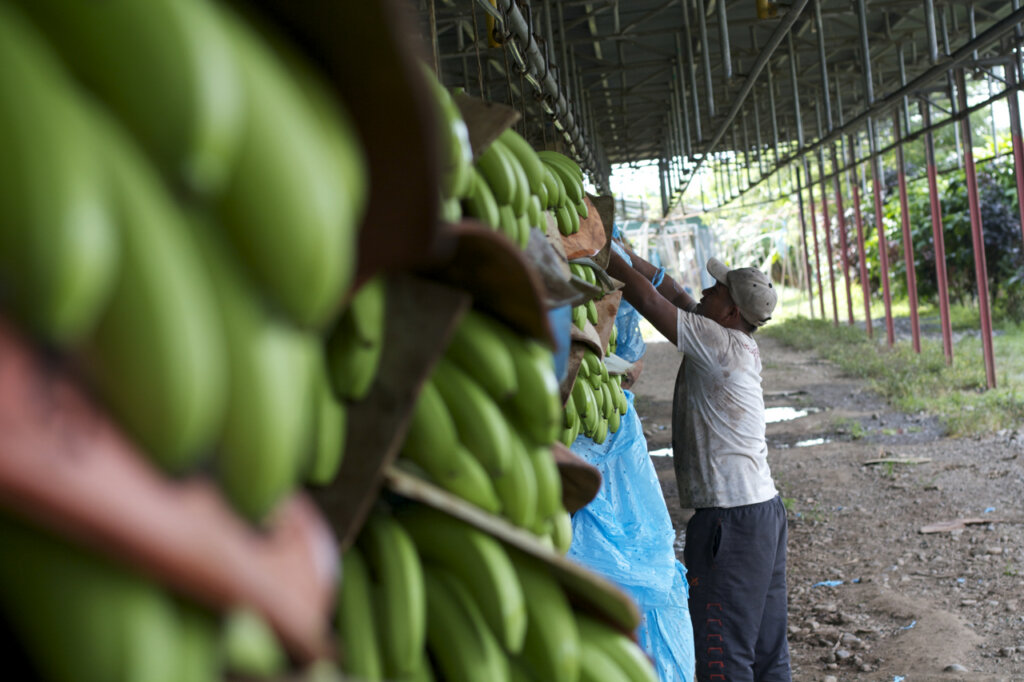
How does the behaviour of supermarket buyers impact wages, working conditions, and freedom of association in the banana industry?
For several years, European retailers have been working together towards securing Living Wages for plantation workers in their banana supply chains. Now a new report into retailer purchasing practices by the Ethical Trading Initiative explores how broader purchasing practices ripple down the supply chain. But what do workers and independent unions have to say? Banana Link’s Holly Woodward-Davey shares the workers’ view.
Industry commitments to change
Over the last five years, a momentum has built steadily among European retailers to ensure that workers in their international banana supply chains are paid a living wage. Starting in 2019, Dutch retailers, coordinated by the Sustainable Trade Initiative (IDH), publicly committed to reduce the living wage gap for workers in their banana supply chains by 75%. Over the next few years, British, Belgian and German retailer groups made similar commitments to work together under a new “Shared Responsibility” approach to addressing a systemic supply chain issue, with the latter opting to work under the coordination of the German development agency, Deutsche Gesellschaft für Internationale Zusammenarbeit (GIZ).
The retailer commitments to addressing poor wages for workers in their supply chains marked a new approach to tackling systemic human rights and environmental risks and violations. Under the banner of Better Together, retailers from the four countries continue to put aside competition as they work towards sustainable solutions for their supply of tropical fruit. Simultaneously, a new wave of European legislation intended to hold large corporations to account for human rights and environmental harm in their sourcing strategies has emerged. In recent weeks, the UK has also announced forthcoming mandatory human rights law.
The Ethical Trading Initiative (ETI) report, Banana supply chain: How purchasing practices influence outcomes for producers, exporters, and workers, analyses how the purchasing practices of European supermarkets put pressure on producers that is passed onto workers in their value chains. Suppliers consulted for the report described how retailers’ commercial decisions strongly shape supply chain and worker conditions. Among the main impacts that suppliers highlighted were:
- Unequal power dynamics: suppliers are rarely able to refuse low prices or unfavourable terms
- Unfair prices: prices often fail to cover the real cost of production
- Higher expectations: increasingly demanding market expectations, without a corresponding price increase
- Audit fatigue: a growing accumulation of overlapping standards, expanding audit scopes and more audit days, alongside divergent technical specifications across markets that increase production costs
- Ineffective living wage fulfilment: suppliers sometimes end up absorbing part of the cost of paying living wages themselves, and suspect that living wage benchmarks are shifting sourcing to countries with smaller or no wage gaps
Importantly, suppliers themselves indicated that poor purchasing practices by retailers do have a direct impact on the workers employed in their supply chains. Poor purchasing practices were linked to the number of workers hired on temporary contracts, the prevalence of job cuts and lay-offs, increased working hours and stress, unpaid overtime and poorer health and safety conditions.
ETI’s report is a valuable tool for retailers to evaluate the impacts of their own behaviour on suppliers and take action. However, it does not include the voice of workers and their trade unions in describing how their own lives are impacted by poor purchasing practices. What do workers and trade union leaders say about how retail purchasing practices in Europe impact the daily lives of banana workers and their union representatives?
Worker’s voice: Latin American and African workers and union leaders describe the impacts of poor purchasing practices
While workers and unions are not privy to the specific contractual dynamics between fruit companies and retailers, they consistently highlight the problem of low prices and the limitations of private certification schemes in defending labour rights. Over the years, Banana Link’s regular engagement and exchange with workers and trade unions in banana producing countries helps us understand what supermarket buying decisions mean for the people growing our bananas.
Unions and workers highlight key systemic issues that play out at plantation level – these include low wages, precarious work, payment by piece rate system, occupational health and safety risks and trade union persecution. Below we will take a look at each of these impacts and what the options are for retailers who want to protect workers rights in their supply chains.
How retailer purchasing behaviour influences workers’ daily experiences
Unfair prices translate to unfair wages
Prices paid by retailers to the first tier of suppliers or, in some cases, directly to producers in banana exporting countries have a direct impact on workers’ incomes. Unions tell us that low prices per box are routinely cited by employers to as barriers to wage improvements or to explain non-compliance with collective bargaining agreements (CBAs). Price deductions based on technical quality criteria defined by retailers, or the payment reduced prices for “surplus” boxes – further entrench the problem of squeezed margins for producers leading to squeezed pay for workers. In some contexts, workers can go unpaid for rejected fruit, face wage suspensions of up to eight days, or even be dismissed, a practice thought to be used intentionally to cut costs and remove unwanted workers.
These examples demonstrate how purchasing practices that prioritise low prices and impose financial risks on suppliers can ultimately transfer the costs of commercial decisions onto workers.
Retail pricing strategies – such as selling bananas below the cost of purchase as “loss-leaders” in order to entice consumers into stores – support the perception among consumers that bananas are cheap, undermining the value of the work that goes into growing, harvesting and packing them. This practice – illegal in some major European countries – must finally be replaced by transparent, fair pricing that includes the cost of protecting workers and the environment.
Overlapping voluntary standards squeeze margins further while offering poor guarantees of labour rights
Independent trade unions recognise that producers are facing higher than ever administrative demands associated with compliance with multiple voluntary certification schemes and retailers’ own private standards. This has a direct impact on a supplier company’s profit margins, aggravating the problem of low prices and further limiting the capacity of companies to increase wages. At the same time, union leaders view these standards as broadly ineffective in protecting labour rights; they also criticise the lack of consultation with unions in the design of private certification and standards.
This aligns with what suppliers reported: the increased administrative workload was linked not only to difficulties in paying workers, but to several other negative impacts, including hiring temporary workers, prolonged working hours and health and safety concerns – impacts which are discussed below. Repeated audits could also lower the productivity of workers – this is particularly concerning given the widespread practice of payment via piece-rates.
Precarious work and temporary contracts
Even though bananas are harvested 52 weeks a year, the recruitment of workers on temporary, part-time and agency contracts has risen across several key banana exporting countries, where workers hired on precarious contracts may account for up to 80% of the entire workforce, according to unions. This reduces labour costs and the commitment a company has to their workforce in the long-term. Employment insecurity also acts as a major barrier for workers to join trade unions, in turn having a knock-on effect on how well workers’ needs and concerns can be raised by unions with management.
Women and migrant workers are particularly vulnerable to contractual precarity. In some contexts, migrant workers report being hired illegally with the use of identity documents belonging to colleagues with national citizenship, leaving them unable to access healthcare despite having social security contributions deducted from their pay-slips, because their own identity documents do not match the name their employer has used to register them in the healthcare system.
Research by Oxfam Germany showed that, in the case of Costa Rica, women earn less than men, while working longer hours to earn their take-home pay: a pay gap of 20% exists despite them working an average of 8 hours more than men per week (a total average of 61 hours per week). In Ecuador, Banana Link research found that women are given less work, often hired informally and only on harvest days, and must travel from farm to farm to make up their income. The prevalence of systemic gender-based contractual discrimination is indicated by the fact that workers, including men, say pregnant women do not work on banana plantations. This allows employers to avoid paying the significant additional salary cost associated with maternity pay.
The trend towards more precarious work on banana plantations happens when companies take a ‘budget’ approach to hiring workers. The reality is that bananas are sold in the UK today for almost exactly the same price as they were 40 years ago.[1] This is despite rising costs of production – with fuel, fertilisers and minimum wages all increasing over this period while the price paid by retailers has stagnated. Under this pressure, companies have moved away from hiring permanent workers on full-time contracts in order to reduce costs. In the context of yearly contractual negotiations with retailers, hiring temporary workers also reduces the long-term commitment a company makes to their employees. The result is poor quality employment for workers, with weaker healthcare and pension provisions and limited access to bonuses, severance, sick pay and maternity pay.
Retailer action to remedy unfair purchasing practices must include not only fairer prices but also timely, predictable remuneration and multi-year contracts. Forecasting should be predictable and last-minute time-line changes avoided.
This allows fruit producing companies to carry out detailed financial planning and invest in their workforces and workplaces. In addition, contracts must be responsive to fluctuations in the cost of inputs such as fuel, shipping or fertilizer to ensure workers can still be paid and access decent work in the event of unforeseen price spikes. Retailers must also recognise the importance of workforce contractual conditions as a key human rights risk indicator and use their influence to advocate for secure work, collaborating with suppliers and unions on what is needed to achieve this and what actions they can take.
Retailers must also recognise the importance of workforce contractual conditions as a key human rights risk indicator and use their influence to advocate for secure work, collaborating with suppliers and unions on what is needed to achieve this and what actions they can take.
Piece-rates linked to increasingly excessive working hours
Payment by piece-rate systems, rather than by the hour, can be linked to excessive working hours and ever-rising productivity targets. Payment by piece-rate means that in order to earn minimum wages, workers must fulfil production quotas – the number of hectares sprayed, bananas harvested or boxes packed– that in some cases are unrealistic, compelling workers to labour well beyond the legal threshold just to take home the minimum wage. In Guatemala – the leading supplier to the United States, but a relatively small supplier for Europe – research has even shown workers earning 35% less than the minimum wage despite labouring for long hours to earn wages under piece-rate systems.
Piece-rate quotas are not subject to the same governance as minimum wage thresholds and in some cases, the production quotas are decided by employers themselves. This means that when the cost of production continues to rise without an associated increase in the price per box, one way that employers can save money is by hiking the production quotas, requiring workers to pack more boxes or harvest more bananas to earn the same wage. The presence of collective bargaining agreements does not automatically prevent employers from hiking piece-rate quotas if their profit margins come under stress.
Occupational health risks
The commercial pressures placed on banana producers can also have serious consequences for workers’ health and safety. Pressure to meet retailers’ price expectations while maintaining production volumes can limit suppliers’ ability to invest in adequate staffing, training and protective equipment.
Trade unions tell us that the long work shifts associated with payment by piece-rate have serious health implications. Since payment is made according to productive output, workers are disincentivised from taking breaks and may rely on energy drinks and other forms of ‘self-medication’ to maintain long periods of physical exertion. Long shifts of manual labour in intense heat on the plantation can cause chronic kidney problems; whilst in the packhouse, long hours are linked to musculo-skeletal disorders. One trade union representative described workers being unable to work past their forties because of exhaustion, leaving a gap between their employed years and retirement age, a cost passed on to the household and the local community in what has been coined ‘social dumping’ by some labour experts.
Beyond the pressure of long working hours and intense production pressure, pesticide exposure remains a systemic, industry-wide risk. Health effects range from skin and respiratory conditions to chronic illness and death. Hundreds of banana workers report infertility caused by pesticide exposure on plantations. Mancozeb, an aerially sprayed carcinogenic fungicide banned in Europe, is still widely used in leading export countries.[2]
In addition, banana bunches are routinely covered with bags impregnated with chlorpyriphos, an insecticide absorbed through the skin. Protection is often inadequate: extreme heat leads sprayers to remove their protective equipment, whilst workers in some producing companies are not always provided with protective masks or gloves by their employer.[3]
When workers are hired on temporary and/or part-time contracts, or when a transient migrant community is a large source of plantation labour, it becomes more difficult to ensure that health and safety measures are adequate: temporary and part-time workers are less likely to receive adequate occupational health and safety training and less likely to be offered personal protective equipment by farm management. In some cases, they are expected to bring their own. Their contractual insecurity also means that they are less likely to raise concerns.
Occupational health and safety risks are likely to be under-reported by workers in general, because pesticide harm builds up over decades and research is not readily accessible to workers. But unions also report that some companies are systemically under-reporting workplace accidents to cut costs by keeping their liability insurance premiums down.
The pressure of years of stagnation in the prices retailers pay for bananas, combined with the relatively short typical contractual period of one year, means producers are not only lacking the financial investment to offer secure work, but, beyond that, to ensure that all workers have sufficient health and safety training and protective equipment.
Trade union persecution
Over many decades of unsustainably low prices, and pressure for producers to reduce the costs associated with a large workforce, a culture of anti-unionism has developed, particularly in some Latin American producing countries. When workers and their unions take action to try and defend workers’ rights, systematic actions to undermine them have developed – from the creation of parallel employer-controlled workers organisations or ‘yellow unions’, pressure on workers to disaffiliate, including through threats to physical safety, dismissal, by making disaffiliation a condition of promotion, blacklisting union members and their families, withholding benefits such as work boots, and selectively cutting piece-rates for union members.
So how to improve these realities?
Bananas are unique in their availability every week of the year. This simple fact provides an opportunity to provide stable and healthy work, but only if retailers can link fair payment to production systems that defend human rights and the environment. Retailers’ commitments towards living wages in the banana farms that supply them is of course a good start. Now these commitments should be extended to ensure that fruit companies are clear that initiatives will not be scrapped when deadlines are reached; long-term solutions to close living wage gaps are worth pursuing. These solutions must be developed through social dialogue and with respect for the nature and time-lines of in-country processes and the local needs of workers. Piece-rate management and payment systems linked to production targets or quotas need to be fully integrated into conversations about wages and decent work.
However, delivering on these commitments also requires retailers to look at their own purchasing practices. Fair prices, longer-term contracts and commercial terms that allow producers to plan and invest are essential if improvements in wages and working conditions are to be sustainable. These are also central concerns for unions, who argue that retailers’ purchasing practices must support, rather than undermine, progress towards decent work and respect for workers’ rights.
Independent trade unions are clear in their view that 1) a living wage is essential; 2) this can only be achieved by linking the increase in the price of a box of bananas to wages, through freedom of association and collective bargaining; and 3) quality, food safety and other private certifications that lack economic mechanisms to regulate wages, conditions and prices are inadequate to guarantee a living wage, compliance with fundamental rights or decent work.
As a solution, they have developed the International Banana Accord (IBA). The IBA is a bipartite framework for dialogue which is designed to enforce labour rights across the entire value chains of signatory supermarkets, created through partnership between African and Latin American unions[4]. In order to guarantee compliance with the 2024 European Union Corporate Sustainability Due Diligence Directive, the Accord establishes specific operational mechanisms to protect fundamental rights as defined by the International Labour Organisation (ILO).
Importantly, the IBA addresses how wages are linked to prices, and establishes a gradual price adjustment to comply with the criteria and methodology for determining living wages which must be included in collective bargaining. The financial viability of suppliers in the chain must be ensured in this process.
In addition to engaging with the IBA and working towards its broad incorporation to banana contracts, retailers could do more to protect workers by negotiating with companies and unions on building terms on labour contracting into their commercial contracts. For example, a commitment to progressively reduce the number of workers hired on temporary contracts or through third-party recruitment agencies and increase the number of workers with permanent contracts could be part of the commercial agreement and linked to the contractual terms around price and contract duration.
Important regional and national differences in worker experiences
Our discussions with union leaders and workers underline the very different working conditions experienced by workers on banana plantations supplying Europe, depending on the country and region in which they are employed. For example, while precarious employment and low wages are systemic issues in some countries and regions, it is not true for all. Colombia’s Urabá region, which enjoys mature industrial relations and a workforce whose majority is unionised, shows that almost 100% formal employment and decent wages is compatible with a competitive, growing export sector. African trade union leaders also report no trade union persecution. In fact, a retailer-supported roadmap towards collective bargaining for living wages has been agreed in Côte d’Ivoire, and in Ghana, the International Labour Organisation (ILO) is poised to launch a multistakeholder living wage programme in the banana sector at the end of 2026.
In countries and regions where industrial relations are strained or even dangerous, retailers can and should support and resource dialogue processes such as these. They can also support unions through contributing to worker education and training and building the capacity of unions to negotiate for wages and working conditions. Retailers can help to ensure that unions are able to adequately participate in international dialogue spaces by advocating for their inclusion and resourcing it where necessary – for example, when international travel to conventions is required.
While work of establishing decent work and living wages for banana workers must be shared by all actors in the supply chain, retailers have the most power to affect change. Banana Link estimates that European retailers capture around 45% of the value of every banana sold, compared to around 24% kept by exporters and shippers, 13% by producers and 5-7% to hired labour, with the rest going to the purchase of agricultural inputs and certification[5]. Unions view them as having the greatest responsibility for change because of this, and due to the powerful position they are in relative to producers and workers.
Conclusion
Retailer price pressure and a lack of long term, stable and fair contracts is impacting workers at plantation level through efforts to cut the cost of labour: by increasingly precarious and informal forms of labour contraction, which reduces workers access to benefits such as pensions and healthcare, with particularly serious impacts for women and migrants; by payment through piece-rate systems, which often lack transparency and independent oversight, leading to intensified workloads and excessive working hours, in turn putting the health of workers at risk. This has a particularly serious risk for workers who are hired to carry out the tasks perceived as of lowest value – often women.
Unions tell us that low prices and profit margins consistently constrain wage growth, while higher prices create enabling conditions for negotiation. However, the ability of workers to benefit from improved prices depends heavily on the strength of industrial relations. In countries with mature social dialogue and strong, independent unions, improved prices can be converted into wage gains and better working conditions. In contexts where significant barriers to freedom of association exist, there is a risk that workers will not automatically benefit from improved prices.
And while responsibility is shared by all actors, retailers have the most power to affect change. Unions have issued an invitation to them to be part of the solution that transforms and industry. It is in the retailers’ hands to react.
This means taking responsibility not only for the prices they pay, but for their purchasing practices more broadly. Responsible purchasing practices must ensure that commercial terms, contract duration and production demands allow suppliers to invest in decent work, respect for trade union rights and a healthy environment. Living wage commitments cannot be achieved in isolation from the purchasing decisions that shape conditions on the ground.
Retailers therefore have an opportunity to turn their commitments into concrete action by adopting purchasing practices that support fair prices, secure employment, meaningful collective bargaining and environmentally sustainable production. Next year, maybe one of the retailers who participated in the ETI research on responsible purchasing practices will be the first to sign the International Banana Accord and usher in a new era of security for banana plantations in in Africa and Latin America.
[1] See It’s Complicated: why your local apples cost more than imports
[2] See https://www.theguardian.com/global-development/2024/sep/17/every-time-the-planes-pass-my-eyes-burn-the-hidden-cost-of-costa-rican-bananas and https://www.upi.com/Top_News/World-News/2025/10/07/ecuador-bababa-workers-complaint-EU/4151759848981/
[3] See https://www.bananalink.org.uk/wp-content/uploads/2025/04/Wage-and-contractual-conditions-among-banana-workers-on-banana-farms-and-plantations-in-the-province-of-El-Oro-Ecuador.pdf
[4] Represented by the International Union of Food, Agricultural, Hotel, Restaurant, Catering, Tobacco and Allied Workers’ Associations (IUF) and the Coordination Body of Latin American Banana and Agro-industrial Unions (COLSIBA) respectively, with the support of Banana Link, 3F and the University of Costa Rica.
[5] Banana Link average estimate, November 2026 for conventional bananas from Latin America