Working Towards A Fair & Sustainable Banana & Pineapple Trade
  • Resources
  • Video
  • Contact Us
Banana Link
  • What We Do
    Our ObjectivesOur AchievementsEUROBANWorld Banana ForumRethinking Value ChainsInternational Alliance for Sustainable Family FarmingMeet The Team
  • Why We Exist
    All About BananasThe Problem With BananasGood Practices In The Banana IndustryAll About PineapplesSustainability Standards & Certifications
  • Where We Work
    CameroonColombiaCosta RicaDominican RepublicEcuadorGhanaGuatemalaHondurasPeruThe PhilippinesWindward Islands
  • Our Projects
    BananEx (TR4)Banana Occupational Health and Safety Initiative (BOHESI)Education & Empowerment In West AfricaGender Equity Across Supply ChainsImproving & Increasing Women’s EmploymentMake Fruit Fair
  • Trade Unions
    Union-To-Union ProgrammeGMB International Solidarity FundCOLSIBACameroonColombiaCosta RicaDominican RepublicEcuadorGhanaGuatemalaHondurasPeru
  • Gender Equity
    Women In The Banana TradeWorld Banana Forum & Gender EquityPractical Progress to Gender EquityGender Equity Across Supply ChainsImproving & Increasing Women’s Employment
  • News & Blog
  • Podcast
  • Donate

Agroecological weed management in bananas

Friday, June 4th, 2021 in: News

We reproduce below an article that originally appeared in the May 2021 edition of Pesticide News, by Gustavo Gandini of BANELINO, which represents 336 Small-scale organic Fairtrade banana producers in the Dominican Republic.


The Pesticide Action Network UK recently collaborated with the UN Food & Agricultural Organisation (FAO) and policy makers in the Caribbean region on ways to reduce and phase out Highly Hazardous Pesticides. Regional expert, Gustavo Gandini from the Dominican Republic, talks here about the agroecological approach to weed management developed over two decades with organic banana producers:

Firstly I should say that the word ‘weed’ does not exist in organic language! Calling them ‘herbs’ instead leads to a different way of managing them and generating added value. We use the following methods to keep these plants at manageable levels within organic banana systems.

  • Biodiverse cropping models, with at least three species (cocoa, coconut, soursop, moringa and non- competitive ground cover) reduce sunlight, create competition and supply organic matter for mulch.
  • Planting banana at higher density, combined with rational management of nitrogen, helps shade out unwanted species.
  • Bananas produce large quantities of organic matter that generate a mulch cover which is renewed weekly.
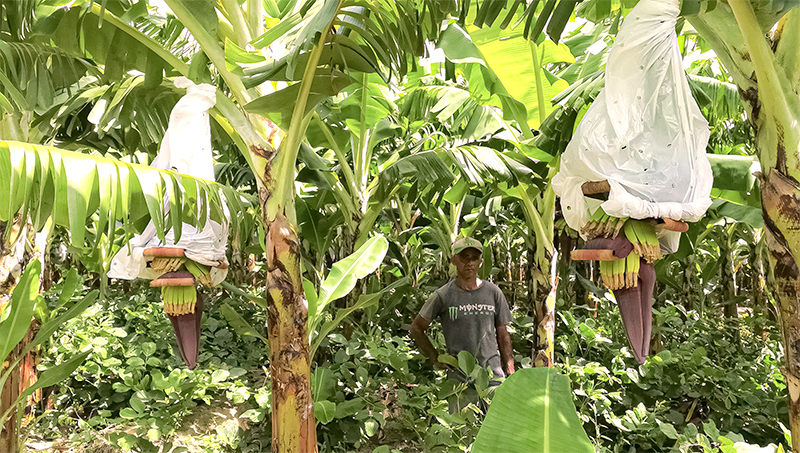
  • Use of ground cover plants, either leaving species to grow naturally but keeping them at a height of no more than 15-20 cm, or planting so called ‘service plants’, usually legumes, e.g. Canavalia, Mucuna bean, to cover the soil. Farmers report that with cover plants they can reduce their manual weeding costs by 80%, needing only to keep plants off the young banana stems.
  • Use of weed killing inputs permitted in organic systems. Some producers have found using high concentration soap has a herbicidal effect. Using undiluted biofermentation products on herb foliage exerts a burning effect, as well as providing soil nutrients after the dead material is incorporated as organic matter.
  • Grazing animals in the banana crop to feed on vegetation. Chickens can be allowed to graze from early morning until afternoon. We use up to 30 hens per hectare, which only occasionally require monitoring. Alternatively, a maximum of 2 goats or sheep per hectare can graze, as long as there is some herby vegetation present, otherwise they may browse the young banana suckers.
  • Considering all these herbs as raw material for composting encourages farmers to cut, collect and process them and then apply them as a nutritive source, with economic benefits and more self-sufficient farm input management.
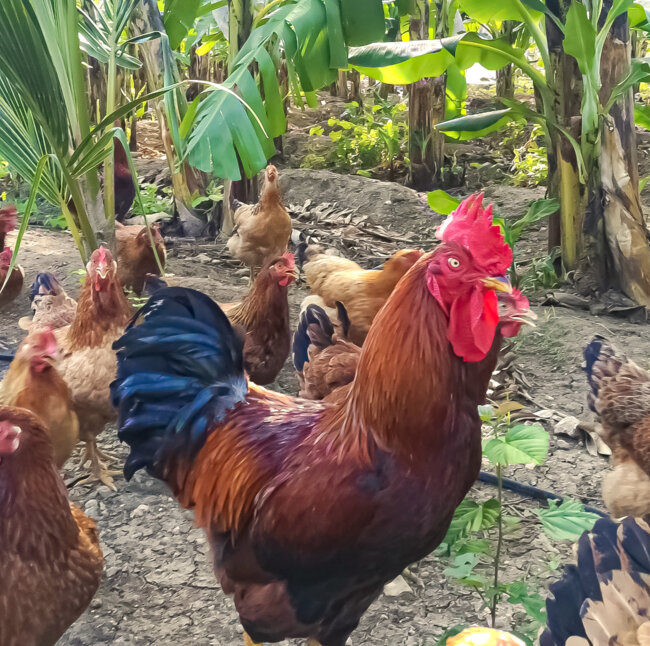
Running chickens to graze amongst bananas as a form of weed management. Credit: Gustavo Gandini

Many agroecological techniques are mutually supportive. For example, by not applying chemical contact or systemic fungicides to manage Sigatoka disease, organic banana farmers benefit from more biodiverse decomposer soil microorganisms, recycling organic matter more efficiently and maintaining a stable mulch cover. In contrast, soils under conventional systems are poor in beneficial fungi and tend to rapidly decline in organic matter. What would help spread agroecological approaches to more farmers are studies to validate and quantify the benefits.

Image below: Ground cover plants between banana rows substantially reduce need for manual weeding. Credit: Gustavo Gandini
Recent Posts

  • Ecuador banana workers: precarious contracts lead to lower wages
  • Costa Rica: Cada vez mas ‘voces en el desierto’ de una cultura anti-sindical
  • Costa Rica: More ‘voices in the wilderness’ of anti-union culture
  • Blog: Fairtrade’s Place in Banana History
  • Costa Rican banana workers receive compensation following complaint against four German retailers
  • UK Government falls short on mandatory Human Rights and Environmental Due Diligence legislation
  • Peru berry workers’ strike underlines need for social dialogue
  • Chiquita to restart operations in Panama following strike, minus trade unions
  • Compagnie Fruitière develops innovative banana production software
  • A just transition in agriculture: putting workers at the centre

Categories

  • Banana Trade Blog
  • News

More News
From Banana Link

29th January 2026 Ecuador banana workers: precarious contracts lead to lower wages

17th December 2025 Costa Rica: Cada vez mas ‘voces en el desierto’ de una cultura anti-sindical

17th December 2025 Costa Rica: More ‘voices in the wilderness’ of anti-union culture

Get Involved

Newsletter
Donate
Contact Us
Banana Link  

51 Colegate
Norwich
NR3 1DD
United Kingdom

Navigation

  • Home
  • About Us
  • All About Bananas
  • All About Pineapples
  • Trade Unions
  • Gender Equity
  • News & Blog
  • Our Partners
  • Our Projects
  • Newsletters
  • Podcast
  • Contact Us
  • Sitemap
  • Disclaimer
  • Privacy Policy
This website uses cookies to improve your experience. We'll assume you're ok with this, but you can opt-out if you wish. Cookie settings Read More
ACCEPTREJECT
Privacy & Cookies Policy

Privacy Overview

This website uses cookies to improve your experience while you navigate through the website. Out of these cookies, the cookies that are categorized as necessary are stored on your browser as they are essential for the working of basic functionalities of the website. We also use third-party cookies that help us analyze and understand how you use this website. These cookies will be stored in your browser only with your consent. You also have the option to opt-out of these cookies. But opting out of some of these cookies may have an effect on your browsing experience.
Necessary
Always Enabled

Necessary cookies are absolutely essential for the website to function properly. This category only includes cookies that ensures basic functionalities and security features of the website. These cookies do not store any personal information.

Non-necessary

Any cookies that may not be particularly necessary for the website to function and is used specifically to collect user personal data via analytics, ads, other embedded contents are termed as non-necessary cookies. It is mandatory to procure user consent prior to running these cookies on your website.

SAVE & ACCEPT